What Is Wake Surfing?
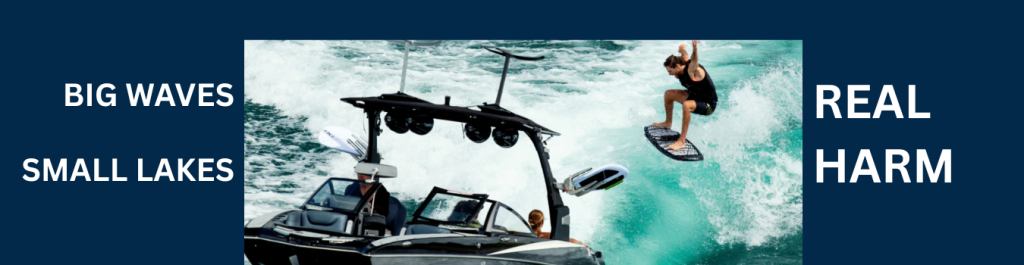
Wake surfing is a recreational activity in which a rider surfs on a large, continuous wave created by a specialized or retrofitted motorboat (“wake boat”). Unlike water skiing or tubing, the rider is not pulled by a rope and stays very close to the boat.
Wake boats are designed to produce exceptionally large and powerful wakes:
- Ballast tanks filled with thousands of pounds of water
- Wake-shaping devices that create waves 3–4 feet high, up to five times more powerful than typical ski boat wakes
- Slow speeds (10–12 mph) that maximize wave energy
- Waves that travel more than 500 feet before dissipating and generate propeller downwash nearly 30 feet deep, disturbing bottom sediments
These wakes behave fundamentally differently from traditional recreational boat wakes.
Impacts on Lakes and Rivers
Environmental impacts
- Shoreline erosion – Repeated large wakes undercut banks and accelerate erosion
- Sediment and nutrient resuspension, resuspending nutrients and increasing the risk of toxic algae blooms
- Degraded water quality, including reduced clarity and oxygen levels
- Damage to nearshore habitat, critical for fish spawning and wildlife
- Spread of invasive species via ballast tanks that are difficult to fully drain and clean.
Public safety and recreation conflicts
- Large wakes can swamp kayaks, canoes, paddleboards, and small fishing boats
- Swimming and quiet recreation become unsafe
- Repeated passes concentrate impacts in nearshore areas such as beaches and private docks
These effects are most severe on the kinds of inland waterbodies that make up the majority of Connecticut’s lakes.
Why Protective Standards Matter
Connecticut’s lakes are generally small, shallow, and environmentally fragile. Without strong, science-based standards, wake surfing can cause lasting and costly damage.
Wake surfing is also an explosive growth industry, quickly becoming the dominant use on some lakes. Well-funded industry groups and wake boat owners are advocating for weak statewide rules—such as operating just 200 feet from shore in 10 feet of water—that do not reflect the scale or power of wake surfing waves and will override local protections.
Rivers Alliance, the Connecticut Federation of Lakes, and twelve other statewide environmental organizations recommend minimum statewide standards:
- At least 1,000 feet from shore
- In at least 30 feet of water
- Only on waterbodies with a regular shape of at least 200 acres
- Preserving local authority to adopt stronger rules or ban wake surfing where necessary
Without clear protections, towns and lake associations are left to respond only after damage has occurred.
Why Your Voice Is Important
State and local decision-makers are actively evaluating how wake surfing should be managed in Connecticut. Public input helps ensure that:
- Water quality and aquatic habitat are protected
- Swimmers, anglers, paddlers, and families are not pushed aside
- Standards are based on science and lake conditions, not political or financial influence
- Local, science-based decisions are respected
On Lake Waramaug, voters in Warren, Kent, and Washington approved a wake surfing ban by 78% following a multi-year scientific study. DEEP approved the ordinance. Despite this clear mandate, well-funded opposition are seeking to overturn the ban through lobbying and legal action.
Speaking up now can help protect Connecticut’s waters—for today and for future generations.
For more information
Check out Protect Lake Waramaug’s website. Protect Lake Waramaug is an organization established and funded by concerned residents of the towns of Washington, Kent and Warren who believe that our lake is just too narrow and shallow for the sport of wake surfing. Our guiding principle is that everyone has the right to enjoy Lake Waramaug, and that the rights of a majority of lake users should not be infringed upon by the small minority of boaters who create hazardous conditions on, under, and along the shoreline of the lake. www.protectlakewaramaug.org.
Other Resources:
Connecticut Federation of Lakes Wake Surf Policy Framework
CT DEEP Wake Surf Study Public Notice
Rivers Alliance’s response to DEEP’s request for comments on scoping for Wake Surf Study
Water Advocates letter of support for Lake Waramaug Ordinance
References
Newer Articles
- A Field Study of Recreational Powerboat Hydrodynamics and their Impacts on the Water Column and Lakebed: https://conservancy.umn.edu/items/6a47c506-6be5-4c8a-9a96-dfea38f23b2f
- Has a nice digital summary as well
- The Effects of Wake Boats on Lake Health: A literature Review: https://wigreenfire.org/2019/wp-content/uploads/2024/05/WakeBoatsLakeEcosystemHealth_WGF-May2024_Final.pdf
Helpful YouTube videos
Organized by state or country
- Connecticut
- Wisconsin
- Terra Vigilis North Lake Management District study
- Summary of Wake Boat Impact Studies, W. Scott Brown
- Chesapeake Bay
- Michigan
- Department of Natural Resources, Wake Boats: concerns and recommendations related to natural resource management in Michigan Waters, September 2022
- Minnesota
- New Hampshire
- Vermont
- Other
Resources Compiled by Protect Lake Waramaug
Protect Lake Waramaug Resources Page
Pro-Wake Surfing Studies and Advocacy